Showing posts with label politics. Show all posts

Friday, November 6, 2015

Disproving V for Vendetta.

“Writers tell lies to uncover the truth.” Evey Hammond the female lead of the movie says her father said this to her growing up. This is of course the point of all fiction, to uncover truth about our society, our religion, our government, and most importantly ourselves. She follows it up by saying, “politicians use lies to hide it.”

The story of V is, presumably, meant to be a fiction meant to uncover truth. Unfortunately it is the opposite. While it does uncover many “truths” throughout the tale it furthers the great myth, the great myth of violence and a violent revolution.

It is not hard to see why anti-authoritarians flock to the show. It is fundamentally a story of the lowest of low, a guy who lives in the shadows and is the ultimate outcast rising up and starting a movement that throws down the overly-authoritarian structure above him. It is the ultimate underdog story. The story of how the lowest rose to be the highest, and how all the evil people at the top were not only stopped, but killed. It is a story of ultimate vengeance.

Anyone who has ever felt cheated or tricked or oppressed by an authoritarian structure is bound to start cheering for this man. And who hasn't at one time been hurt by authority? Whether it was a parent falsely accusing you of something your sibling did, or a teacher who went out of their way to make your life miserable. In some way, in some often extremely painful and personal ways, we have all been cheated by “the man” and deep down have some urge to get back.

The character who plays the high chancellor and spews constant anger and irrational hate makes everyone hate him. Everyone watching wants him punished in some way to bring justice. When I learned about Hitler, Stalin, and Ne Win in history the temptation is to think, oh if someone just would have killed them then imagine how many lives would have been saved! Imagine how much better the world would be. It is as if the dictator is the one wholly and completely responsible for the mess. This is of course a lie.

The dictator is just a symbol, a symbol of the character of the people. No one rises to power, except on the backs of other people. If at any moment the Russian people as a whole were like, nope, I am not going to do anything this person says, then Stalin would have been on the streets in a week. V talks about this in his “revolutionary speech.” One of the truly great pieces of writing from modern movies:

And the truth is, there is something terribly wrong with this country, isn't there? Cruelty and injustice, intolerance and oppression. And where once you had the freedom to object, to think and speak as you saw fit, you now have censors and systems of surveillance coercing your conformity and soliciting your submission. How did this happen? Who's to blame? Well certainly there are those more responsible than others, and they will be held accountable, but again truth be told, if you're looking for the guilty, you need only look into a mirror. I know why you did it. I know you were afraid. Who wouldn't be? War, terror, disease. There were a myriad of problems which conspired to corrupt your reason and rob you of your common sense. Fear got the best of you, and in your panic you turned to the now high chancellor, Adam Sutler. He promised you order, he promised you peace, and all he demanded in return was your silent, obedient consent.”

It isn't always “their fault.” Of course those that rise to power are more guilty than we, but if we are singing their victory, praising their name, voting for them or in anyway acknowledging their legitimacy to rule, then we are part of their rise to power, we are to blame.

Government is a creation of language. It only exists in our minds, and only exists because we allow it to. V points out this power of language in his revolutionary speech:

I thought we could mark this November the 5th, a day that is sadly no longer remembered, by taking some time out of our daily lives to sit down and have a little chat. There are of course those who do not want us to speak. I suspect even now, orders are being shouted into telephones, and men with guns will soon be on their way. Why? Because while the truncheon may be used in lieu of conversation, words will always retain their power. Words offer the means to meaning, and for those who will listen, the enunciation of truth. And the truth is, there is something terribly wrong with this country, isn't there?

Just as language is the tool to build government, language is the tool that can destroy it. Notice how he talks about talking. “taking some time out of our daily lives to have a little chat.” “Words offer the means to meaning, and for those who will listen, the enunciation of truth.”

Words are used to create meaning, but only to those who are willing to listen do they offer truth. Only those willing to go through rigorous debate, those willing to be challenged, will ever know truth, but whether we are willing to listen to not, words do create meaning.

It is simple to see how this happens in real life. I say something like “I am the king, you must serve me.” This is of course a completely false statement. However, if I get everyone to repeat it, and if I can somehow enforce punishment if anyone says otherwise, then it becomes a maxim. A “truth” that is accepted without any thought. Particularly when it becomes so accepted that if anyone dares to question it they are laughed at and ridiculed and viewed as “crazy” “extreme” “fringe” or a “conspiracy theorist.”

In the relentless repeating of the lie, the lie becomes truth and anyone who doesn't believe it is insane. However deep down we know it to be a lie because it is obvious. How am I fundamentally any different than any one else? What would make me a king on a different moral level? Even to ask these questions is to expose the myth. In an “Emperor's new clothes” fashion, the whole thing crumbles.

Wherever you see this sort of Fight Club oppression you know there is an accepted “truth” that is a lie. The first rule of fight club is you cannot talk about fight club. The first rule of an abusive relationship is you cannot talk about that abusive relationship. The first rule of the family club is you do not talk about the family club. An abusive husband knows he is being an abusive. An abused wife knows she is being abused. To talk about it, is to end it. No abusive husband wants his wife going around the neighborhood saying, “my husband beats me.”

The movie is startling accurate in its portrayal of many aspects of the world, though significantly different than our own. In the movie a member of the media team says, “It is our job to report the news, not to fabricate it, that is the government's job.” How incredibly accurate a description of the mainstream media's relationship to the government. The media simply churns out whatever the most recent press release is from the government and puts some analysis and spin on it and calls it good.

However despite the fact that I love the movie and shows much truth, its ultimate "truth" is indeed a lie.

It propagates the biggest lie of all: that violence is useful. That somehow we can make up for the sins of violence with more violence. That somehow killing those bad guys in power is a great good. “Violence can be used for good.” Is the claim that V makes to Evey.

We want violence to be used of good. We want the bad guys to die, the bad guys to pay for their crimes and for the good guys to win. It jives with our sense of justice. Our sense of right and wrong. But guess what, it doesn't work.


Every violent revolution in history from the French to the Russian to the Chinese has inevitelby led to the removal of the bad guys and the replacement with a worse guy. The Russians removed the oppressive Tsar to be replaced with the most murderous man in history, Stalin. The French took down the king and replaced him with Robespierre who killed more than the king ever did. Violent revolutions always fail because it takes an even more violent person to remove a violent one. Violence can not beat violence because it does not take down the lie of the ruler, it enforces it.

As stated already, the government's power does not come from guns, it comes from language. It comes from saying that it is right, from saying that violence is the answer. The way to destroy that is not with violence. If you try to conquer it with violence it is not tearing down the lie, it is enforcing it. It is saying that violence is indeed the way to solve problems. But the way to defeat the government is not to enforce the lie, but to question it.

You want to change the world? A violent uprising is not the way to do it as you will become the beast you are trying to destroy. The revolution happens in your mind. It happens here, right now and then it spreads from one mind to the next. Simply think of statements that we accept as unilaterally, unequivocally true.

Democracy is good. Public schools are good and necessary. Taxation is the foundation of civilization. Anarchy is chaos. Respect for authority is good. Obedience is a virtue.

Are these things really true? Or do we just assume they are because we have said them a million times and it is generally accepted as true? If examined it is not hard to realize the above statements hold about as much water as “I am the king and you should do what I say.”

What truisms do we say, but never live? For example Honesty is a virtue. Yet if a child is honest about his school class and says “My teacher is boring” is he praised or punished? Do we really value honesty? Or do we value obedience? Because you can't have both.

At one moment the police chief is beginning to question the government. He is beginning to realize that maybe he is working for the wrong team. He says to the liutennet: "If our own government was responsible for the deaths of over a hundred thousand people... would you really want to know?" That is the question everyone must ask themselves. To be honest the answer for most people is "no" which is why things continue as they do. Whether we want to know or not, the truth is that since WWII the u.s. military has killed over ten million people. Ten million. That is one hundred thousand... times a hundred. And the body count is much higher. But you can just ignore that. You can go back to your entertainment television and be happy. Or you can begin to ask some hard questions. You can begin to have some conversations that people are desperate for you not to have.

Despite its flaws the movie contains this great line, “Beneath this mask there is more than flesh. Beneath this mask is an idea, Mr. Creedy, and ideas are bulletproof.”


Saturday, October 24, 2015

More Game Than Reality

Game of Thrones is an exciting, albeit violent, medieval fantasy novel and TV series. The special effects are incredible, the characters interesting as they are disturbing, and the story writers extremely good at getting you to watch the next episode. But behind the stunning visuals is a story that goes largely unseen by the viewers. Whether you are a die-hard fan, or a casual viewer, hopefully in the next few paragraphs I can open your mind to whole new levels of meaning in the epic fantasy Game of Thrones. I will divide my review into three parts, the magic and its meaning, the politics of thrones and the politics of today, and finally critiques and inconsistencies.

Part 1: The magic and its meaning.


Magic and the medieval era seem to always go hand in hand, but Game of Thrones is almost void of it except for a few elements, the white walkers in the north, and the dragons of Daenerys Targaryen and a few other minor elements.

Magic in literature can almost always be taken as a symbol of insanity. Probably the best example is the beloved children’s series Harry Potter, which is the imaginative re-telling of the trip of a severely abused and neglected boy (Harry) to a mental institution (Hogwarts).

The “White Walkers” are essentially a zombie army in the frozen land of the north. The only people who have seen the White Walkers are the “Night’s Watch” a group of men who through choice, or through force (mostly force) have given up everything, i.e. the company of the opposite sex, the chance to see or have a family, and more, in order to supposedly “protect the kingdom.” Many are there because of incredibly traumatic reasons, such as being abandoned by family or as part of a plea bargain. As seems to be rampant in all military situations, abuse, anger, and fighting are rampant.  
Now what if, after making all these sacrifices and living in this near hell, you realized that there was no real threat? The wall is ridiculously large, and no one would ever get in, and it is in the middle of a frozen desert. You will stay on the wall all your days, never have a family, never do anything meaningful, and not really be useful or create any value to anyone. The acceptance of that reality would be ridiculously difficult and painful. The desire to have a real enemy and a purpose for your existence would be enormous. Traumatized people are forced into alternate universes where the trauma and pain can, if nothing else, be meaningful.

“The White Walkers” are easily interpreted as nothing more than the creations of severely traumatized soldiers. The parallels to our own world and soldiers should be apparent, where imaginary white walkers are the least of our problems, but the men having the illusions could be.

The dragons follow a similar pattern. Khaleesi (among my favorite characters) is a girl whose only family member, her brother, is a complete sociopath who is happy to have a whole army rape her if it will be beneficial to him. After being told this absolutely horrific thing by her brother, that same brother essentially sells her to be the wife of a borderline rapist who for entertainment at their wedding watches women being raped and men being killed. If trauma exists, this is it. If this were your lot in life, suddenly being the “mother of dragons” who could birth all-powerful dragons that caused men to do whatever you pleased would sound pretty nice, especially since it is men who ruthlessly and harshly disregarded her life. Being able to control men with her family’s emblem, the dragon, would be almost infinitely appealing.

Magic makes movies fun and interesting, but often hides a lesson about trauma and coping mechanisms.

Part 2: The politics of Thrones and the politics of now.


Most everybody is appalled by Joffrey, the young boy king in the movie. He is brutal, he is mean, and he is a coward, unlikeable in every possible way.  But the people around him, such as his mother and the other kings vying for the throne, are not much better. Basically the show is about a bunch of sociopaths who go around ordering people around and killing whoever gets in their way or for whatever whim they have.  

It is kind of crazy that these characters are even relatable, because they are nothing like you or me.
A testament to the messed up nature of the show (and the world that cheers it on), is that deep down we are cheering for Ned Stark and his family. Ned Stark and his family seem to be the only good guys.

But remember something about Ned Stark. He opens the show by chopping off a head of a man he has barely met and only listens to for about 30 seconds of testimony/defense. Chops off his head! To make things worse, he forces his 10 year old son to watch. In what planet is that man a good guy? The political planet.

Ned Stark only seems like a good guy because next to Joffrey and the like he is a saint. Compared to prostitutes we may all seem like chaste virgins, but that does not make it so. It is not like our virtue is increased by being surrounded by people that lack any. Ned Stark, despite what virtues he may exude is a man who abandons family for power and who kills men without trial in front of his young son. 

This is the supposed good guy.

The parallels to today are painfully clear.

Ned Stark (and his family), are the “good politicians” The guys who are finally going to “fix the system.” They are loving, they are caring, they are compassionate. They will get rid of the bad guys and restore order, rule in justice, end the war, etc. etc. That may sound far-fetched and ridiculous, but listen to the rhetoric around any politician running for president this coming year: it will sound the same. If you are in team [enter candidates name] that candidate can do no evil. This is what we think. If only Rob Stark (i.e. Bernie Sanders or Ron Paul or Hillary Clinton) gets into power, then the system will be fixed. That is what we tell ourselves every single year. And just like in Game of Thrones, we keep watching hoping “Joffery” will be killed and the murders will stop, but just like in the show the murders, the killings, the rapes, the brutality never stop. The Ned Starks of the world keep the system going, by keeping us hoping a violent system can in some way become non-violent.  
The Game of Thrones, for ways I will discuss in the next section cannot be midlevel era, largely because of the large scale constant war which was impossible before the industrial revolution. No, Game of Thrones is not about medieval war, it is about the wars of the post-industrial western world. 
The Game of Thrones is the modern world in many ways. The U.S. government has been at war almost non-stop since World War II. They have propped up dozens of dictators around the world, set up governments to support their causes, and tear down any government that threatens their rule. The government today is the real life Game of Thrones, and it is every bit as bloody as the medieval drama. And as much as we would like to exonerate Ned Stark, no man’s (or woman’s) hands are clean.

We like to think our politicians are beyond the brutality of these medieval barbarians, but look at the drone strikes which kill school children and wedding guests. These are the people who will send down bombs on an innocent family gathering, and hardly feel remorse about it.

These are people who will send thousands of men into Iraq to die, and hardly flinch or worry about the validity/necessity of the war.

These are people who prop up dictators in foreign countries and sell weapons to brutal regimes around the world.

These are people who will take a mother from a child simply because they don’t have the proper piece of paper.

These are people who will throw thousands in prison because they don’t agree with the vegetation they keep.

And it all just keeps going because we keep believing it is somehow necessary, keep believing that somehow “the good guy” will finally come in and kill Joffery and all the bad guys, and there will be peace! This is the great fallacy of the human race, the belief that somehow we can destroy violence with violence. It never works. The violence will never stop, the wars will never cease. Just like Game of Thrones, as long as people keep watching, the violence continues, but the moment we turn away, is the moment it disappears and the show will cease to be aired.

Part 3: Critiques, irrationalities/inconsistencies, and economics


Game of Thrones has some compelling and well done story telling. There is a reason I got as far as I did. And as stated at the beginning, visually, aesthetically, etc. the movie is great.
The biggest problem is the show’s plot and premise are so completely irrational and inconsistent that the whole thing gets so utterly ridiculous that it requires too much suspension of the rational mind.
A story can contain magic and dragons and it is okay, as long as the movie is internally consistent. That is fire cannot move in one direction one minute, and a different the next, unless the rule is fire constantly moves (which would be interesting.)

First and foremost, Game of Thrones deals with human entities, so there are some basic rules that a storyteller must accept when using humans.

1. Humans do not like/want to die and will do most anything to avoid it. 

2. Humans need food to live

Not too complicated, and pretty indisputable. Sure there are some humans who want to die, but those are a very small fraction of society at any given moment. 

Game of Thrones breaks both of these rules almost constantly. Most of the characters are completely given over to the author’s whims to keep the plot going, without any sort sense of desire to survive, or any ability to get food.  Every level of the society is either irrational or ignored. The peasants and lower-classes are ignored and killed on whims by the other classes without any reference to the essential function they carry out in society. Kings, knights, soldiers all depended heavily on peasants and the lower-classes for everything, sure they could kill a few to make a point, but they were a valuable resource which the kings would not have been able to just slaughter at the drop of a hat.
The soldiers are assumed to have no sense of will or morality whatsoever. This is the stereotype and in many ways the reality of soldiers, but many soldiers do maintain some level of morality, and even more than that, the desire to survive. The show assumes that not only do soldiers have zero regard for the lives of other people (which is semi-believable), they also have zero regard for their own lives (which is not believable).

The ruling class does irrational things right and left because they want to, and because it makes the story last longer. The whole story is the story of the irrational decisions of the ruling class (much like our history books). But what makes this unbelievable (as opposed to the history books) is the rulers often act against their own self-interest in ways that would decrease their wealth or chance of survival.  Sure rulers do a lot of crazy and irrational things, like invading Iraq, but we can look back on that event and realize with Haliburton and all, there was a lot of self-interest driving that decisions (and bloody ruthlessness). What wouldn’t make sense if George Bush had instead decided to invade Uruguay, kill everyone in the country, burn all the resources in the country, have half the army kill themselves, take what was remaining of the army and send them into Indiana where they did the same thing. That would make no sense, but that is about the level of rationality that goes on among the Thrones rulers.

Like so many modern stories, the people who make them have no sense of technology or economics, or just the basic reality that people need food to survive.

People look at the medieval ages as a brutal time, but life expectancy actually took a small bump from Roman times, mostly because there weren’t so many wars. Yes you read that right, less fighting. Sure there were really long wars, but our conception of warfare is nothing like medieval warfare.
In modern (as in post-US Civil War) warfare the wars generally last 2-10 years with frequent fighting and battles. World War I lasted 4 years, with men constantly in the trenches and having battles every few months. By Korea and Vietnam wars soldiers faced near constant fighting. Compare this to medieval war. In the 100 years’ war, which was at the pinnacle of the medieval times (1337-1453) there was on average less than one battle every two years! A king would call for all the Lords, they would bring the men and they would go fight, for one day, and that would be it for the whole year. If the battle was particularly bloody there would be no battles for multiple years as the kingdoms recouped.

When people write these ridiculous stories they have no idea the crazy amount of resources it takes to go to war. In medieval times these resources were simply not available for large constant warfare. You could not have year-long wars because your soldiers would starve to death. There just was not enough food. This is the same reason that peasants did not go to war, and why you simply did not kill peasants willy nilly. Each peasant dead meant less food and resources for you and your army.   
Also another thing to note is the size of the battles. From the shows it is difficult to get clear statistics about the demographics of the “seven kingdoms.” To be fair, in Roman times larger armies and battles were able to be created simply because there was a larger government with a large kingdom. However, in the typical battle in the 100 years’ war there would be 5-10 thousand men on each side going into the battle. The winner would lose a few hundred men; the loser would lose a few thousand men. In other words all of France or England would be able to field one army of approximately 8000 men for one battle for a whole year. That was it. In all of England only 8000 men would be in battle for the whole year. Of those 200-2000 would likely be killed in any given year to war. And that is it. Why? Because they could not afford to go to war more, there was not enough food. One can only steal so much food from a farmer, before the farmer is on the verge of starvation himself; when it gets to this point, threats of violence become meaningless. As the ruler the option is to steal what is left of the food (and the farmer dies of starvation) or kill the farmer, either way this means less food the coming year because there is one less farmer.

It is these fundamental realities about life and economics that the writers of Thrones are completely oblivious of.

A king makes a calculation just like anyone else. Put yourself in their shoes. You are the Lord/King of the north. You control a large area where people pay tribute to you and you get food. What should you do? Take your huge army, loose thousands of men, and go attack the capital? Or a neighboring lordship? Maybe, if you could steal more resources than you would lose through the war, but the reality is that going to war takes TONS of resources, so one has to be pretty dang confident it is going to work, because it is a huge risk. This is why in medieval times the operations were generally small and calculated. Sure kings made mistakes and were even irrational and lost thousands of men at times on bad decisions, but their decisions were reined in by economic realities. Just this one rational thought makes much of Game of Thrones nonsensical. But unfortunately it does not stop there.
What is their motivation of the soldiers to fight? They are paid, so that keeps them going for the routine task, but when going to war, no amount of money is worth a person’s life (i.e. almost no one would say, “I’ll kill myself if you give me X dollars”) This is what people often don’t understand about war. Soldiers do not fight for love of country, or whatever B.S. propaganda says. Soldiers fight because they take a calculated risk about money and their chance of survival or (as is more often the case)  there are men standing behind them who will kill them if they do not fight.

The common soldier is stuck between two enemies: The enemy on the other side that is coming to destroy them, and their commanding officers who will kill them if they desert. Once again people, even most soldiers, care about their lives and will not risk it without some pretty compelling reasons, like getting killed.

This makes lots of the scenes with soldiers completely nonsensical, because the soldiers are treated as people without morals and the will to live.

There are many ridiculous scenes that could be analyzed, but just to look at one, the scene where King Joffery has all the bastard sons of the previous king killed. The scene is completely ridiculous (at least based on the information given). First off there is no way they could track down those sons. The previous king had sex with prostitutes regularly. These prostitutes had sex with tons of men regularly (they are prostitutes after all). It would be impossible to track down whose sons were whose, so that whole thing is ridiculous. Then to add on some ridiculous crème, a group of three soldiers go and search out this one bastard son, who has joined “the night’s watch.” The leader of “the night’s watch” group threatens them with violence. There are two or three soldiers. What would they do? They would leave and just say they couldn’t find the boy (or even that they found him and killed him, because honestly who is going to know?), that is the way that involves the least violence and risk to their own lives. The fact that they come back and try to fight for some random boy is just absurd. Also in this episode, soldiers literally pull babies from mother’s arms and kill them. I find it extremely difficult to believe that this would not lead to full-scale, all out revolution. People are not easily pushed to revolution, but seeing babies murdered by the king would probably do it if anything did.

The list could go on and on with irrationalities and inconsistencies and plot holes. The general problem is that people consistently act contrary to their own self-interest, which in real life rarely (if ever) happens. People make miscalculations and mistakes, but to consistently do opposite what any rational human being would do makes things real difficult to take seriously.

“I’m Ned Stark’s wife, I’m going to let Jayme Lannister go, because meh, no reason.” Then some random guy kills some kids for no good reason, then the Rob Stark kills the guy despite knowing he is going to lose half his army. Basically the author decided bad things needed to happen to Rob Stark’s army to keep things interesting, so let’s have everyone in his army go completely insane and irrationally killing each other.


No family is saved from the irrationality. I do not except people to be moral, in fact all the opposite, people in power rarely are moral, which is one thing the show actually does represent well. But what it does a horrible job of showing is people understanding the true economic cost of violence which in reality is what controls how kings and countries act in wars, how long the wars last, how many men fight etc. To just ignore the economic drivers behind war and assume everything (or even anything) is about sitting on some stupid throne, allegiances, loyalties, and other inconsequential matters is to completely misunderstand the very thing the show is supposed to be about. 

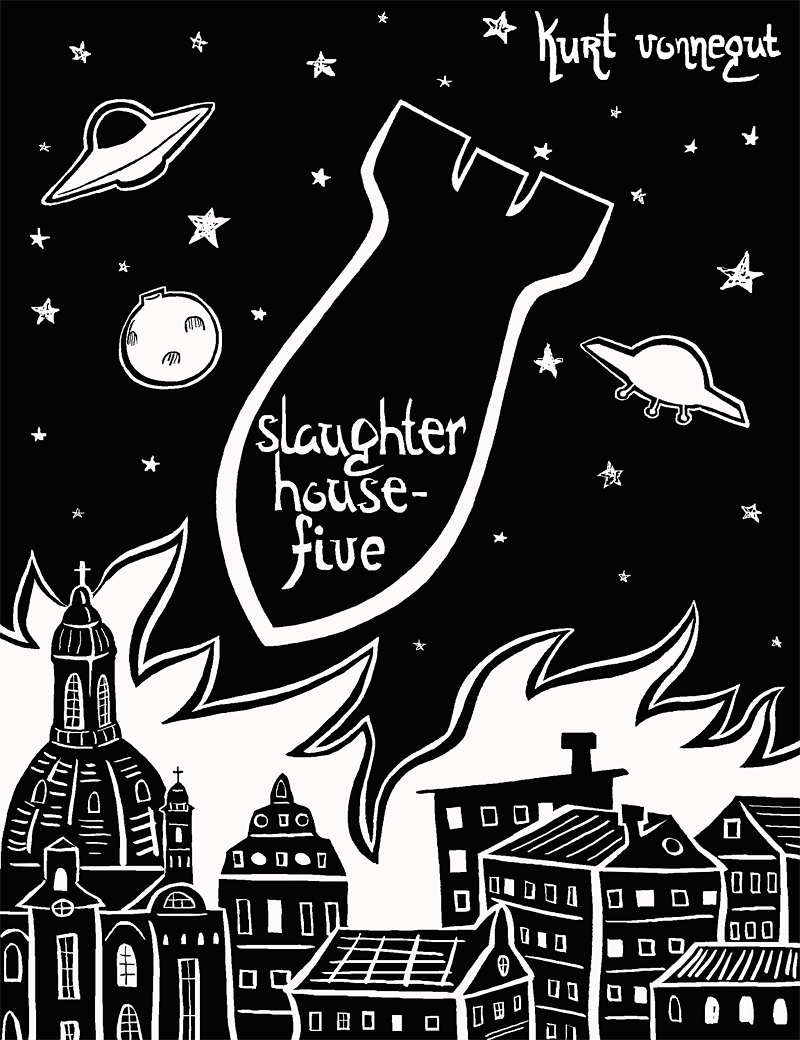
Slaughter House-Five's Deeper Layers


Title: Slaughterhouse-Five
Author: Kurt Vonnegut
Published: 1969
Rating: 4.5 (out of 5) 

The alternate title for the book is A Children’s Crusade: A Duty-Dance with Death. At The beginning of the book the author claims to be writing a book about the battle of Dresden, a lesser known allied air-strike where more people died than at Hiroshima. A wife of one of the author’s friends is angry he is writing a war book because war books always glorify war. She says they were just children fighting in the war. He agrees to call it A Children’s Crusade. In many ways, modern wars are no different from the children’s crusades of the middle ages.  

In war we send out 18 or 19 year old men, but in many ways they are children, they do not know what they are doing. This sets the tone for the rest of the book which I find to be symbolic of war, even though the actual war is talked about very little.

Most the book is nonsensical. The story is told in a completely non-linear fashion. The first part which talks about the author, but the rest is about an optometrist named Billy Pilgrim. Billy claims to have been abducted by aliens that see in the fourth dimension. They teach him the “true nature” of time. They can all go to any moment at any time. They can look at moments in time like we look at the rocky mountains. This leads to the convoluted story telling. Billy believes this and can somehow jump from moment to moment. He tells about part of his story during the war when he is in Dresden, then he is back in the states before the war, then back in the war, then at another point in the war, then getting married after the war, then when he is old, then when he is in school, and so on. By the end the reader is able to piece together his whole life, but it is like putting a puzzle together.

This is in many ways like war. It doesn’t make sense. After we see destroyed buildings and bits of pieces of information from different survivors and with that a story is pieced together which eventually becomes the narrative thousands of school children will recite on tests. Yet it is not the story of the war. We learn a broad story of events that logically follow one another and culminate in victory for the good guys. The history of America’s wars in most history books read more like a Victorian novel or an epic Greek poem. For the actual soldiers, it doesn’t make sense. There are bombs, explosions, going here and there and they don’t even knowing why. There is a reason tons come back with PTSD and other ailments: they just went through hell, and the worst part about it is that it is senseless hell.  This is the reason the bombing of Dresden is not well known, because it does not fit the narrative. The good-guys don’t just bomb a completely unprotected city for no reason and kill thousands of civilians for no apparent reason. So what do we do, we skip over that. We get Hitler Bad, Hitler attack, Winston Churchill good, Churchill save day, American fighting men save the day, allies win, world saved! Yet this is not the story of war: this is the fantasy of those that don’t want to understand.

In this story Billy talks about visiting space aliens and going through time warps and all this stuff. It is all kind of crazy, but nothing compared to the craziness of sending bombs down on innocent people, but so it goes.

The aliens Billy meets are also very deterministic. There is no ability to change the course of events. Each moment happens because that is just how it is constructed. Billy knows when he is going to die, but he does nothing because that is just how it is. Throughout the book whenever someone dies (which is almost every other paragraph) it is followed by the sentence: So it goes. As if that is just how it is. Of course, to the man in the army this is how life feels, this is how war feels. You cannot choose where you go, or when you leave, or even when you go to the bathroom. It is all controlled by some external and seemingly arbitrary force. Life is completely controlled. You are a mere pawn in some scheme that you are completely incapable of fathoming.

And that is slaughterhouse five. It is not a story about a crazy optometrist who gets abducted by aliens. It is about some children, 18 and 19 year old children, sent on a crusade they didn’t understand. It is about the crazy stories they have to create to make sense of their lives. Billy Pilgrim is not insane for seeing aliens; the world around him is insane that escape to aliens is a better alternative than reality.


The book is definitely worth a read, so read it, or don't. This is the anarchist Review: reading without rulers.

The Hunger Games' Deeper Layer


The Hunger Games has captivated readers and audiences alike over the past years since its release. It has sold over a million copies and pulling in almost 700 million at the international box office. It is easy to guess why. The book is a fun and full of non-stop excitement. The read is well-paced and keeps you on edge. Love, romantic conflict, violence, beauty, sex, nostalgia, the book has it all. Here at The Anarchist Review the question we put forward to the reader is what does The Hunger Games mean to our society? That is a question we attempt to answer. (Note: this is a review of  The Hunger Games book not its sequels or the movie.)

There is no shortage of doom porn floating around libertarian circles. The Hunger Games feels like it could fit in nicely next to 1984, Fahrenheit 451, and Brave New World  for a perfect libertarian doom salad. The common theme of such libertarian reviewers is that our future is held in these books unless we change something. 

Indeed, there are many parallels between Panem and our current situation, but first for the benefit of the .1% of the population who has not seen or read The Hunger Games let me give a recap of the scenario.  A country called Panem in North America is divided into 12 districts and the Capitol. Each district specializes in producing some item, most of which goes to the Capitol. The districts are varying in wealth, but are mostly poor. The closer the connections one has to the capital, the wealthier. The protagonist is from the coal-producing District 12 which is located in current Appalachia.  The Capitol is in the Rockies (Salt Lake City?).  The Capitol rules the citizenry with an iron fist. To further demonstrate its power over the districts and avoid rebellion, once a year they hold the Hunger Games. Basically two people (a boy and a girl) between the ages 12 and 18 are chosen from each district to battle to the death for the entertainment of the Capitol.  Every year 24 kids are thrown together and only one survives, the Victor, who is lavished with wealth and fame. Obviously going to the games is a death sentence, so it is dreaded in the districts.

As of now Washington D.C. does not hold gladiator type games between teenagers from the different states. Also, D.C. is much closer to Appalachia than to the Rockies. So not a perfect fit, however there are some very relevant comparisons between The Hunger Games and today’s society.

In Panem your wealth is tied not to your work ethic or good ideas, but rather where you were born, or rather how close to the capitol you were born. The Capitol controls who is wealthy, who succeeds, who is poor and who fails. With federal spending exceeding three trillion dollars, and billions more handed out to Wall-Street via QE and other monetary trickery of the Federal Reserve, the Panem system is not that much different than our own.  Maybe you are laughing at me saying this is a ridiculous comparison. But is it?

The U.S. government spends 40% of GDP. That means if you take everything that all 300 million people make, the government spends 40% of it. That is a load of money. Google had revenues of 15.7 billion last year, Wal-Mart did 469 billion. The U.S Government spent 3,455 billion dollars in 2013. That means the spending power of the largest company in the world was less than half, less than a seventh of what the U.S government unleashes in terms of spending power. Google, the supposed king of the internet can only unleash 0.5 % of what the Federal government can. Companies make or sell products that we choose to use. The U.S. government simply pulls the money out of our paychecks without permission. Imagine how much you can influence who is wealthy and who is poor when you can outspend any other single entity by seven times? Also when you are able to take arbitrary amounts of money from people’s pocket books and distribute it to whoever you wish?

The unfortunate reality is that so much of success is not based on a company’s ability to provide a good or cheap product. It is based on the company’s ability to get on the government’s good side. Look at the Sugar industry in the United States. In 2013 The Florida Sugar Cane League, the American Sugar Alliance, and American Crystal sugar spent over 3.5 million dollars in lobbying. As a result Sugar in the United States has a large protective tariff and over the past 40 years has cost as much as double in the U.S. as opposed to outside it. Every regular person in the United States is essentially paying for politicians to get wined and dined by the Sugar Lobby. They pay in higher sugar prices, increasing the price of all their food and increasing the wealth of lobbyists, politicians, and Sugar corporations.

Look at the successful business in the world. Look what industries are hiring and giving big bonuses to their CEOs? Go to job fair. What businesses are there? If it is a technical/engineering job fair I can almost guarantee who you will see: government supported monopolies (i.e. utilities) the government (bureau of land/water management), and government defense contractors (Boeing and Lockheed Martin). Why is that? It is because they have a steady stream of “guaranteed” dollars flowing in from the Capitol. 625 Billion dollars were spent last year alone on building the war machine. That is 625 billion dollars taken out of people’s pockets, people that actually produce something people use, like computers and software and hotels and houses, in order to pay for bombs and a bunch of engineers to sit around and make death machines.  If they produce a product that no person would ever buy, it matters not. The money is there.

Go to none-engineering career fair. There will be a large swab of companies from education, healthcare, and finance. Three industries which are heavily regulated and subsidized by federal and state governments. Once again the government has chosen who succeeds and who fails. 


In The Hunger Games, the people in the Capitol do not work at all; they spend all their time on frivolous activities. The people in the Districts have incredibly strict laws that they cannot leave their areas, and barely have enough food to live.

What about here? For the most part, the capitol is not filled with people who spend their time dying their hair other colors and getting plastic surgery. Washington D.C I have heard actually has a pretty hard working atmosphere; everyone is a busybody trying to get things done. Which is scary.  However, what do they really accomplish? They write words on a piece of paper. They make laws. The tell people well where to move their guns. They produce nothing. They produce nothing that people can use. Their paper-passing is just as frivolous as the lives of the hair and prep team from the Hunger Games. The protagonist says this of them “It’s funny, because even though they’re rattling on about the Games, it’s all about where they were or what they were doing or how they felt when a specific event occurred. ‘I was still in bed!’ ‘I had just had my eyebrows dyed!’ ‘I swear I nearly fainted!’ Everything is about them, not the dying boys and girls in the arena.” 

Is it too much of a stretch to assume that politicians may be just or even more callous than these hair-dressers? They get their money by looking good and sounding nice and not offending people. They get their money by getting donations from wealthy people in trade for special privileges that hurt everyone else. They send thousands of men and women to die in Iraq and Afghanistan and they sleep peacefully at night in their suburban homes paid for by the labor of productive Americans. They argue about laws and send papers around from one office to another while men are dying because of their actions. Is this any less frivolous, any less callous than the speech of the hair dressers?

True, we do not have most the country working to pay for the lavish lifestyle for the politically connected, except we do. We do not callously ignore the deaths of people who die in the name of the country, yet we do. Since 2004, when drone attacks begin, as many as 951 civilians, which includes 200 children, have been killed by drones in Pakistan alone. This does not include the wedding guests who died in Yemen and other deaths around the world

Are we that far from The Hunger Games? Is our society really that much different than the one we look upon with such abhorrence? We let over 4,000 of our own die in Iraq so we could be unified and patriotic. Are we that much different than a society that lets 24 of its own fight to the death to maintain peace and order in society? Is this not exactly what the deaths of all our military is all about? That is why we have parades and ceremonies for the survivors, for the Victors if you will. Is there a difference?

Hopefully by now the reader is questioning if we are not exactly who the Hunger Games is talking about. You may be convinced that The Hunger Games is the day after tomorrow for America. Well I hate to burst your doomsday bubble, but it is not. Despite my radical political opinions, I affirm that this will never happen. There will be no Hunger Games here. Ever. How can I say that? What evidence is there?

We are not at the base of state power, we are at the pinnacle of it. This three-thousand year-old paradigm of the state is fading with Slavery and other barbaric institutions of the past. Will the powers that be relinquish voluntarily? No, of course not. Evil will not relent. Evil people will hold on with all they have to the source of power and livelihood. The state has created millions of dependents. This is of course to the state’s advantage because it means millions are interested in keeping it alive and well. But in the end it cannot. The state is simply inefficient. Violence and evil do not help people, do not produce good results, and do not produce anything of value. The state cannot compete with ingenious and innovation and entrepreneurship. It just cannot. Despite all the taxes, all the regulation and other violent actions the state will raise against free people attempting to serve others, but in the end it will be to no avail. The progress of man cannot be stopped.
Generally the villain is not taken down by the good guy, the villain is taken down through his (or her) own vanity, pride, irrationality, lust for power, or whatever it be. His own arbitrary authority is what will implode and destroy the bad guy. And so it will be with the state. Technology will get better so that free-seeking people will be better able to escape the state. Bitcoin. Sea-steading. The internet. All sorts of things will help to set us free. And the state will be left alone, and all the evil it harbors, crumbling under its own complete inefficiency. There is no stopping the revolution. There is no stopping the revolution.

In these hunger games it will only be evil that will be starving. And I can’t wait.

Let the games begin. 


Les Miserables' Deeper Layer

Can you hear the people sing, singing the songs of angry men, that is the music of a people who will not be slaves again!  - From Can You Hear the People Sing in Les Miserables

Here they talked of revolution
Here it was they lit the flame
Here they sang about tomorrow
And tomorrow never came
Oh my friends, my friends, don’t ask me
What your sacrifice was for
Empty chairs and empty tables
Where my friends will sing no more
-From Empty Chairs and Empty Tables in Les Miserables


Les Miserables is a fantastic tale of love and loss, justice and mercy, revolution and power. It has enchanted and inspired millions. The interplay of personal stories interwoven into the grand story of the failed French Revolution of 1832 is fantastic. There are so many applicable topics The Anarchist Review could cover in this story: religious freedom versus political freedom or Justice versus mercy, but I have chosen the topic of revolution.

Multiple questions are brought up by this tale: What is Revolution? Who starts revolutions? What is Revolution good for?


A little background on Victor Hugo, the author, and why he wrote about this. Hugo personally witnessed some of the proceedings of the 1832 revolution or June Uprising as it is referred to. As in the play/book/movie, the uprising lasted only two days: from June 5 to June 6. It was in fact a pretty minor blurb, especially considering the large number of uprisings and revolutions that France has been through. If it were not for Victor Hugo this uprising of 3,000 people, would have faded into the annals of history known by only to a few erudite historians. 

Thanks to Hugo, however it is one of the most well-known events in history. Hugo himself was a Republican, and strongly sided with the republican revolutionaries.

Now to the tale of revolution. During the song Red and Black, Enjolras, the revolutionary leader, asks if revolution is “simply a game for rich young boys to play?” He says (or rather sings) this at the ABC pub where wealthy middle-class men come to discuss politics. Most are young, some are sons of aristocrats. These young men feel they are liberating the poor from oppression and “They will come one and all. They will come one and all” to support them in their just cause. However, their prediction is fatally wrong.

Revolution is often assumed to start with poor disgruntled workers who rise up to shake off the shackles of their oppressive governments. Yet Les Miserables is saying the opposite, that it is a bunch of wealthy middle class men who get angry and try to stir up the masses. 

So what is the revolutionary story? As one who has considered tattooing, “Liberty or Death” across his back, it would be nice to sympathize with revolutionaries. Perhaps, however, the story of Les Miserables has lessons, particularly for young fire-brands like me.

So without further ado, The Anarchist Review takes a quick plunge into the history of revolutions to uncover the truth.


Revolutions generally go through three stages, the fall of the old regime and rise of a moderate regime based on the old paradigm just adjusted, rise of a radical (and often tyrannical) government, and a return to moderate in the so-called Thermidorian reaction. Crane Brinton notably analyzed this in his book The Anatomy of Revolution. Though it is not a perfect fit for all revolutions, many of the large revolutions in history have followed this pattern, most notably the English, the French, and the Russian.

Brinton points out that it is not the super poor who start revolutions. Genuine lower-class revolutions are almost non-existent with the notable exception of Haiti’s slave revolution. The revolutionaries are generally idealistic middle-class white guys, “born of hope,” as Brinton puts it.


In the first stage, the moderate stage, the relatively unorganized middle-class men who have gained support of the lower-classes often because of extreme conditions are able to take down the first regime. This is the exciting stage where the lower-classes are involved. They are not the instigators, but they jump on the cause, mostly because they assume things cannot get worse than the status quo.  This group often is unorganized and lacking a strong leader, they often do not want to completely oust the former government as much as they simply want to change it. In France this meant forming a constitutional monarchy. They wanted to keep the king, just add restraints and grant more power to the middle-class. After all it is a middle-class revolution, the poor are involved in creating chaos, but when the tables come out and negotiation begins, they are not present.

The next stage is where an organized radical group with a strong leader sweeps in and takes control. In England it was Oliver Cromwell, in France, Robespierre, in Russia, Lenin.  Are these men from humble backgrounds who strive to help their fellow poor brothers? Let us have a look:

Oliver Cromwell: He was born into the middle-gentry, i.e. upper-middle class. He was a land-owner and politician for most of his life. Not exactly what we would consider a “worker.”

Robespierre: A politician and lawyer descended from lawyers. Robespierre, despite being from a somewhat troubled home (born out of wed-lock), he was just about as middle-class and white-collar as they come.

Some revolutionary spirit during Robespierre's Reign of Terror

Lenin: He was born to nobility. Yes, you read that right, Lenin, the Marxist radical of Russia was born into a noble family. It is not true that his parents were not born noble, however they were born rich. Before Lenin was born they were basically awarded a title and became “hereditary nobility.” Lenin, like so many Marxists, knew more about the plight of finding a good chef then they did about the plight of workers.

This is not meant to be an exposé or surprising revelation. These men are not really considered great men of history. All three were at the helms of extremely violent and bloody regimes. But they fit the bill of the radical revolutionaries of the world. Men with great idealistic visions which when attempted to put into practice end up killing loads of people. For example, Robespierre’s short rule in France led to over 40,000 deaths.
After the radical stage there is a return to a moderate stage, and often, in the long run a return to the former government. In France and England a King was returned to the throne (albeit with constitutional restraints), and Russia, well Russia still has the sort of strong dictatorial leaders it has head since the time of the Russian empire.

Revolutions results? Day to day life of workers ends up being basically the same. Religions and habits remain unchanged. As Brinton says, “[The revolutions’] results look rather petty as measured by the brotherhood of man and the achievement of justice on this earth. The blood of the martyrs seems hardly necessary to establish decimal coinage." Basically in the end the revolutions are, like most wars, fights between rich people about who can exploit who, with the lives of poor people often being tossed around as collateral. A few of the rich kids playing the revolutionary game die as symbols, but most of the blood shed is the blood of workers whom the revolution is supposed to benefit. The Reign of Terror in France which was meant to uproot all royalist support, killed far more people from the lower classes then it did nobility or royals. 

From looking back at history it seems Victor Hugo had revolutions about right. One of two things happens. The middle-class revolution gets support from the lower-classes and causes chaos and uprising. The government changes three or four times and ends up basically how it started. The other possible scenario is the one told by Hugo. The lower-classes do not come to support the cause because of misjudgment of how bad their plight actually or unwillingness to die for the cause. In either case if you start the revolution you probably end up dead with your friends wondering what your sacrifice was for.

Here at The Anarchist Review we have plenty of revolutionary blood. Those that know me know I am anti-establishment and idealist. Lots of people probably assume I would be the first one running down the street waving a Gadsden flag to start the next American revolution.

However, I have to side with history. Revolution in the end is a game for rich white boys to play which almost always ends in meaningless violence. It is a bunch of rich kids who look at the lower-classes and say, “I know what they need.” When in reality they care more about aggrandizing themselves, then helping the poor. They have grandiose ideas not rooted in reality. They claim to fight for liberty when in the reality they are seeking power.  Outside of the American Revolution, it is difficult/impossible to find a revolution which could be remotely described as “successful.”

Despite all my fiery gusto for change and revolution, I am afraid it is the slow gradual changes that win out. Why? Because people are gradual changers, society changes gradually. And while government is not society (a common error); government, at least partially, reflects society. Ultimately government only changes because it has to. Society changes government, it is impossible to do it the other way around. People, not power, rule the world. So despite my radical leanings and position, I feel I must give deference to that great conservative thinker Edmund Burke who predicted the French Revolution spiraling out of control.

“It is a general popular error to suppose the loudest complainers for the public to be the most anxious for its welfare.” – Edmund Burke


My suggestion for young men like me who so greatly yearn for change in the world is not to turn to guns, violence, and revolution, but rather to reason and technology, thinking and persuasion, that is how we will win the war.

Do not go start political revolution. Stay home, get married, have children, raise them peacefully, write a book, and live another day.

 If we go the path of revolution we will end up like those of Les Miserables, with “empty chairs and empty tables, where [our] friends will sit no more.”